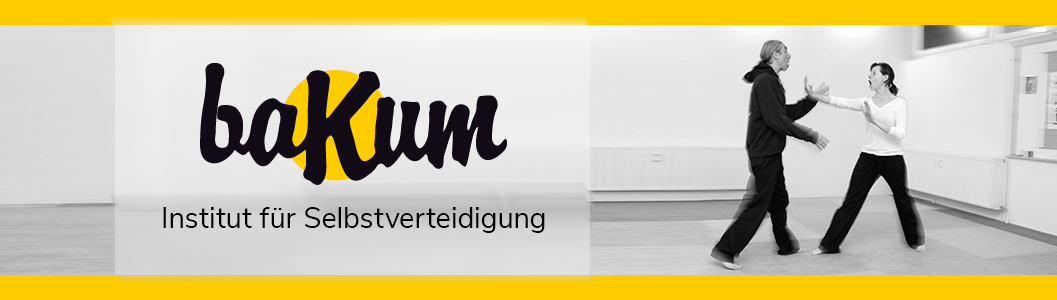
Violence prevention training for children at baKum helps children develop confidence, recognise potentially dangerous situations, set personal boundaries and learn how to seek help. The programme combines age-appropriate behavioural training, self-assertiveness and suitable self-defence techniques.
Children may encounter situations in which they feel uncomfortable, threatened or pressured. This can happen in public places, on the way to school, during leisure activities or in everyday interactions with other people. Children need to know that they are allowed to say NO, that their feelings and personal boundaries matter and that they can ask for help whenever something feels wrong.
There is no complete protection against violence. However, children can learn important principles and develop skills that help them recognise risks and respond more confidently.

Content and Aims of the Training
The aim of our violence prevention training for children is to strengthen their self-confidence and help them develop practical strategies for dealing with difficult situations.
The programme focuses on the following areas:
- Building self-confidence: Children learn to trust their own perceptions, recognise their strengths and develop a stronger sense of self-assurance.
- Recognising dangerous situations: Children practise identifying situations in which they may need to be particularly careful or seek assistance.
- Dealing with strangers and unfamiliar situations: They learn to maintain a healthy awareness, question unusual requests and recognise when someone is trying to persuade or pressure them.
- Developing assertiveness: Children learn that they are allowed to set boundaries and that their personal space and feelings deserve respect.
- Saying NO with voice and body: They practise expressing refusal clearly and confidently through words, body language and a strong voice.
- Getting away and asking for help: Children learn that leaving a threatening situation and finding a trusted adult are often the most important responses.
- Age-appropriate self-defence: The programme introduces suitable physical self-protection techniques for children.
Learning to Say NO
An important part of the training is learning to recognise and communicate personal boundaries.
Children sometimes find it difficult to refuse requests, especially when an older person or someone they know puts pressure on them. They may worry about being impolite or getting into trouble.
We help children understand that they are allowed to say NO when something feels wrong. They can refuse unwanted contact, leave uncomfortable situations and ask trusted adults for support.
The training also helps children understand that they do not have to keep secrets about situations that frighten or upset them. Asking for help is a sign of strength, not weakness.
Parents and educators looking for additional guidance on personal boundaries and child safety can also explore the NSPCC’s Talk PANTS resources.
Confidence Instead of Fear
Our approach is based on strengthening children rather than frightening them. We do not want children to grow up believing that danger is everywhere or that they are responsible for preventing every possible act of violence.
The responsibility for violence always lies with the person committing it. Children should never feel guilty if they are unable to prevent or resist an assault.
Instead, the programme gives them practical behavioural tools and encourages them to trust their feelings, communicate clearly and seek help when necessary.
Course Organisation
The courses are designed for groups of approximately 10 to 20 children, aged between 5 and 10 years. Training takes place at locations where children commonly gather. This allows the programme to be organised in a familiar environment and adapted to the needs of the participating group.
Basic course:
- Duration: three hours
- Group size: 12–25 children
- The courses take place where the children commonly gather
- Basics: three hours, 500 EUR (e.g. 25 children, each at 20 EUR)
Advanced: another three hours (recommended twelve months later) - Focus: confidence-building, recognising risks, assertiveness and basic self-protection.
Advanced course:
- Duration: three hours
- Recommended follow-up: approximately twelve months after the basic course.
- Focus: refreshing and developing the principles and skills previously learned.
An Experienced Trainer
The training is led by Udo Kumpe, an anti-violence trainer and director of the baKum Institute for Self-Defence in Berlin. His work focuses on violence prevention, de-escalation, self-assertiveness and practical self-defence. His professional experience includes working with people affected by violence as well as with perpetrators of violent offences. The programme is based on practical experience and aims to give children useful skills they can apply in everyday life. Learn more about baKum, our background and our approach to violence prevention on our About baKum page.
Information and Booking
Are you interested in organising violence prevention training for children at your school, nursery, club or other institution? Please contact baKum to discuss the course, suitable group arrangements and available dates. Our aim is to help children develop confidence, recognise their personal boundaries and know how to respond when they feel unsafe.
Strong children know that they can say NO, leave a situation and ask for help.